November 2021
Ants
Ants can adapt to species, resources or environmental conditions. This means that there will be unusual behaviours between species. One such is the ant species Pheidole oxyops (1) that deliberately places bird feathers around the entrance to the ground nest (Gomes et al 2019).
The nest has "a peculiar structure, with a wide, deep, and smooth entrance tunnel, which is thought to work as a pitfall trap, enhancing the capture of arthropod prey... Feathers may thus further enhance prey capture, given that they may work as bait (due to their smell, colour or shape) to some arthropods that end up falling into the nest entrance tunnel. In addition, it is possible that feathers directly benefit ants, as they could obtain food from small residues of bird tissue or from prey present in the feathers" (Gomes et al 2019 pp451-452). Alternatively, the feathers may act as moisture retainers and supply the colony with water in the dry Brazilian savannas where these ants live (Gomes et al 2019).
Gomes et al (2019) tested the two possibilities - feathers to aid prey capture, or as moisture retainers. In relation to the former explanation, the researchers built pitfall traps (similar to the ants' nest entrance) with feathers around them (n = 10) and without (n =10) in the university grounds in Brazil. Gomes et al (2019) explained: "After 48 h, we collected the pitfall traps and took them to the laboratory, where the arthropods were sorted into morphospecies. If feathers do enhance prey capture, we expected that traps with feathers would collect more arthropod species and individuals than would traps with no feathers" (p452). Significantly more arthropods were found in the feather-traps than the controls, even after removing non-food species for the ants.
To test the hypothesis about feathers and water, during the dry season the researchers removed the feathers from around twenty-eight nests in Minas Gerais, Brazil. Half the nest had water-soaked cotton balls left instead ("water-addition group"), and half nothing ("no-water group"). After three days a handful feathers were left near the nests. Gomes et al (2019) outlined their expectations: "If feathers act as a water source for ants, we expected that the no-water group would collect more feathers than the water-addition group" (p453). There was no difference in the number of feathers collected between the two groups. Gomes et al (2019) admitted that "this experiment was conducted over a short period of time; it is possible that three days were not enough to produce significant changes in water availability to the nest" (p455).
Overall, this research supported the idea that these ants used the feathers to enhance a passive strategy of prey capture (ie: "sit and wait" for prey). But Pheidole oxyops also actively seek prey away from the nest (Gomes et al 2019). The arthropods caught in the pitfall traps suggested an increase in diet diversity compared to active prey seeking (Gomes et al 2019).
Ants using traps is rare, but it has been observed in the plant-ant Allomerus decemarticulatus, who construct a gooey platform on the plant they inhabit to capture large insects that land there (Dejean et al 2005).
Gomes et al (2019) did not test other hypotheses for the feathers including as camouflage of the nest entrance against predators, or as protection against potential flooding of the nest in the wet season.
Dejean, A et al (2005) Insect behaviour: Arboreal ants build traps to capture prey Nature 434, p973
Gomes, I.J.M.T et al (2019) Why do Pheidole oxyops (Forel 1908) ants place feathers about their nests? Ecological Entomology 44, 4, 451-456
(1) General information about this species at https://www.antweb.org/description.do?genus=pheidole&species=oxyops&rank=species&museumCode=MCZC.
OCTOBER 2021
FROGS
Mating systems vary between species, and usually depend upon parental investment needed. Where offspring require much and/or lengthy parental feeding, say, monogamy is common, while "promiscuous mating" (polygamy by both sexes) usually goes with little parental investment needed.
Frogs as a generalisation tend not to pair bond, but de Sa et al (2020) described an exception in the frog Thoropa taophora (1), that lives inbetween rocks (saxicolous). Found in the Brazilian Atlantic rainforest, males defend freshwater seeps flowing on the surfaces of outcrops and rocky shores as breeding territories for females to deposit eggs, and then defend the tadpoles against potential predators. It was found that a male would mate with two genetically unrelated females (a dominant and a secondary) "recurrently and exclusively" during the ten-month breeding season. This observation represented "the first case of single-male polygyny with reproductive fidelity in amphibians..." (de Sa et al 2020 p1) (or "harem polygyny").
The researchers observed the frogs in Sao Paulo State for a total of 138 hours over fifty three nights, and video recorded sixty hours. The tadpoles were genotyped to establish parentage.
The males defended their territories with aggressive calls, body-raising postures, and physical attacks on intruders.
The genotype of tadpoles in seven breeding seeps found the dominant female was the parent of 86% on average of them, and the secondary female 14%. de Sa et al (202) pointed out: "Overall, developmental stages of tadpoles assigned to the two females overlap entirely, indicating that the dominant and secondary females mate multiply with the same male several times during the breeding season. We define this multiple mating by mated pairs as reproductive fidelity. We found no evidence of females or males mating in more than one breeding seep, even when neighbouring seeps were only a few meters apart" (p2).
The researchers emphasised the scarcity of breeding sites as key to the mating system, as well as the ability of males to monopolise/defend them. "Males reach higher reproductive success not only by monopolising scarce breeding resources but also by maintaining females and aggressively excluding all other conspecific intruder males from their territories. The fitness benefits of breeding site monopoly must be extremely high, explaining male investment in intense and, likely costly, aggressive behaviours. High male intra-sexual aggression can also select for sexual dimorphism in weaponry that females lack. In T. taophora, this is reflected in the enlarged male forearms and keratinised thumb spines..." (de Sa et al 2020 p2).
The males also have to defend one female's set of eggs from cannibalism by the other female. For females, the benefits of "sharing" a male with a high-quality breeding site compensates for the risk of cannibalism. "When critical resources are unevenly distributed, a female mating with an already paired male at a superior-quality breeding site will most likely have equal or higher reproductive success than a female mating with an unpaired male at a poorer-quality site, thus promoting polygyny" (de Sa et al 2020 p2).
de Sa, F.P et al (2020) Unexpected reproductive fidelity in a polygynous frog Science Advances 6, eaay 1539
(1) Details of species at https://amphibiaweb.org/species/7305.
SEPTEMBER 2021
CRAYFISH
"Pharmaceuticals are ubiquitous in aquatic ecosystems globally and are recognised as environmental contaminants of concern" (Reisinger et al 2021 p2). Simply, humans excrete or dump pharmaceuticals into the water supply. The concentrations are very low when measured in the environment generally, and are "below the threshold at which most pharmaceuticals are lethal to model organisms tested using standard ecotoxicology methods" (Reisinger et al 2021 p2). But acute exposure (ie: high concentrations) or chronic exposure (ie: long-term) can have non-lethal effects on ecosystems (Reisinger et al 2021).
Reisinger et al (2021) focused on the anti-depressant, selective serotonin reuptake inhibitors (SSRIs), which increase serotonin levels in the human brain, and the freshwater crayfish. Changes in the behaviour of this species from the pharmaceuticals will alter the whole ecosystem.
The researchers had created artificial stream ecosystems in their laboratory in the USA. There were four conditions - control (no crayfish and no SSRI), crayfish only, SSRI (citalopram) only, and crayfish/SSRI. Three male spinycheek crayfish (Faxonius limosus) (figure) were used in each condition, and the experiment lasted fourteen days.
The behaviour of the crayfish was scored for boldness (eg: time to leave shelter to seek food), and aggression (eg: approaching other males) in a specially designed maze.
The males exposed to SSRI were significantly bolder than controls as shown by a shorter time to emerge from shelter (mean 67 vs 119 seconds). The SSRI-exposed crayfish spent more time foraging than controls, but avoided conspecifics.
The increase in boldness and spending more time foraging in a real environment would make the crayfish more vulnerable to predators. Reisinger et al (2021) summed up: "Overall, the behavioural changes caused by citalopram exposure could reduce crayfish population sizes by increasing vulnerability to predation, but they could also increase per capita impacts of crayfish on the environment by increasing foraging rates" (p14).
The study lasted 14 days, and it may be that the effects of SSRIs take longer (eg: 4-12 weeks to accumulate within the body). Consequently, the researchers were unable to detect changes in the ecosystem due to the behaviour changes of the crayfish, though there were hints of possible effects. For example, if the crayfish exposed to SSRI spent more time foraging, their food sources could be depleted (eg: invertebrates).
An "environmentally realistic" concentration of citalopram was used (0.5 microgram per litre; µg/L), though higher levels have been found in real-world studies. Note also that some experiments directly injected SSRIs into the animals studied (Reisinger et al 2021).
Reisinger, A.J et al (2021) Exposure to a common anti-depressant alters crayfish behaviour and has potential subsequent ecosystem impacts Ecosphere 12, 6, e03527
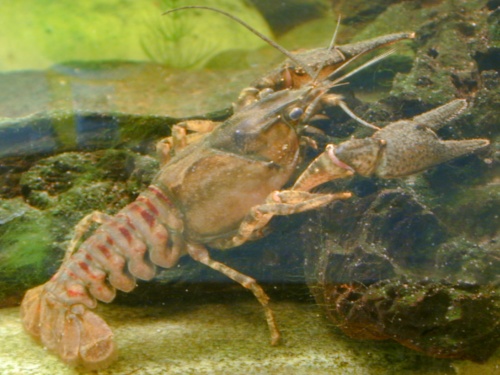
(Source: Andreas R Thomson; in public domain)